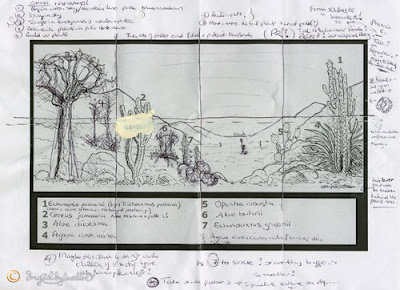
Today, before working into the mountains, I decided to widen the cactus on the right. I added a criss-cross pattern to indicate where the spines would go - this lattice pattern is very common in plants of all types.
  Ooh! A sudden drip on my head made me look up. It was raining outside, and as the rain got progressively heavier it began to leak through the glasshouse roof. I noticed a few streaks of water on my painting ...
 I played 'dodge the drips' for the rest of this painting session! Fortunately acrylic paint, when dry, is waterproof. As long as the rain didn't pour onto my freshly painted areas, it would be OK.
*
I worked into the distant mountains with more blue mixture. This time I used Ultramarine Blue, with Titanium White, Yellow Ochre and a touch of Burnt Sienna. This gave a nice hue which I made more mauvey by adding a little Cadmium Red Medium.
 I decided to remove one of the barrel shaped cacti, as the arrangement looked a little cluttered. I did this by sponging over some Titanium White mixed with a touch of Yellow Ochre, and applied two more layers in this way.
*
The rocks were given form by adding a mixture of Burnt Sienna, Yellow Ochre, Titanium White and Ultramarine Blue. For the green definition on the cacti I added some Cerulean Blue to Yellow Ochre and Titanium White and then a touch of Lemon Yellow .

Some detail was added to the Aloe on the left - I worked in some of the rosettes of leaves and the markings on the trunk.
 Drip drip drip went the rain ... and more appeared on my painting. This was a little more worrying as it was running down an area I had just painted, and was washing some of the colour off in streaks. Not a lot I could do about it, so I just got on with painting elsewhere on the mural.
 There were really loud sploshings coming from across the room. The table with some (fortunately laminated!) information sheets on was really getting wet, so I walked across to move some of the items.
*
It was then that I saw the face ...
 Across the giant lily pond, nestled among the potted cacti was a little prickly pear with a face like a surprised bunny!
 I wondered if it was astounded at my painting methods ... It looked quite shy, so I went softly back to my mural.
 Now for a bit of definition!
*
The rocks were given form by adding a mixture of Burnt Sienna, Yellow Ochre, Titanium White and Ultramarine Blue. For the green definition on the cacti I added some Cerulean Blue to Yellow Ochre and Titanium White and then a touch of Lemon Yellow .

Some detail was added to the Aloe on the left - I worked in some of the rosettes of leaves and the markings on the trunk.
 Drip drip drip went the rain ... and more appeared on my painting. This was a little more worrying as it was running down an area I had just painted, and was washing some of the colour off in streaks. Not a lot I could do about it, so I just got on with painting elsewhere on the mural.
 There were really loud sploshings coming from across the room. The table with some (fortunately laminated!) information sheets on was really getting wet, so I walked across to move some of the items.
*
It was then that I saw the face ...
 Across the giant lily pond, nestled among the potted cacti was a little prickly pear with a face like a surprised bunny!
 I wondered if it was astounded at my painting methods ... It looked quite shy, so I went softly back to my mural.
 Now for a bit of definition!
*
I mixed a darker green with Lemon Yellow, Ultramarine Blue, a little Titanium White and Yellow Ochre. This I applied in the crevices of the cacti.

For the shadowy areas of the boulders I used Burnt Sienna, Yellow Ochre and Ultramarine, with a touch of Titanium White. I am always careful not to overdo this defined shading - it's tempting to rush in and do too much.

Reluctantly I decided it was time to finish, to let the painted areas dry before working into them any more. The rain had stopped, the dripping was lessening and I could hear the crickets chirping in their tank. As I closed the door behind me, I wondered if the little bunny faced cactus would trot across and have a closer look at the mural as soon as I had gone ...

For the shadowy areas of the boulders I used Burnt Sienna, Yellow Ochre and Ultramarine, with a touch of Titanium White. I am always careful not to overdo this defined shading - it's tempting to rush in and do too much.

Reluctantly I decided it was time to finish, to let the painted areas dry before working into them any more. The rain had stopped, the dripping was lessening and I could hear the crickets chirping in their tank. As I closed the door behind me, I wondered if the little bunny faced cactus would trot across and have a closer look at the mural as soon as I had gone ...